
Blogs
Tile Roof Repair Sydney: 2026 Costs, Common Failures & Lifespan

I climbed onto a tile roof in Earlwood last March after the heaviest
February rain on record. The homeowner had two ceiling stains, both
growing. She thought she had a leak in one spot. I pointed at four. The
valley between her main roof and the back addition had lifted 14 mm at
the join, three terracotta tiles upstream had fractured (probably from
the hot January then sudden cold rain), and the ridge bedding along her
south-facing line had broken away in three sections.
She didn’t have one leak. She had a roof that had been quietly
working for 30 years and had just hit the wall.
This guide is for Sydney homeowners trying to work out whether their
tile roof needs repair, what it’ll actually cost, and whether the fix
will hold. We’ve been repairing tile roofs across Sydney for 14 years.
Most weeks we’re on three or four different roofs. The patterns barely
change, and neither do the prices.
How Much
Does Tile Roof Repair Cost in Sydney in 2026?
Here’s what we actually charge as of April 2026:
| Repair type | Price | What it includes |
|---|---|---|
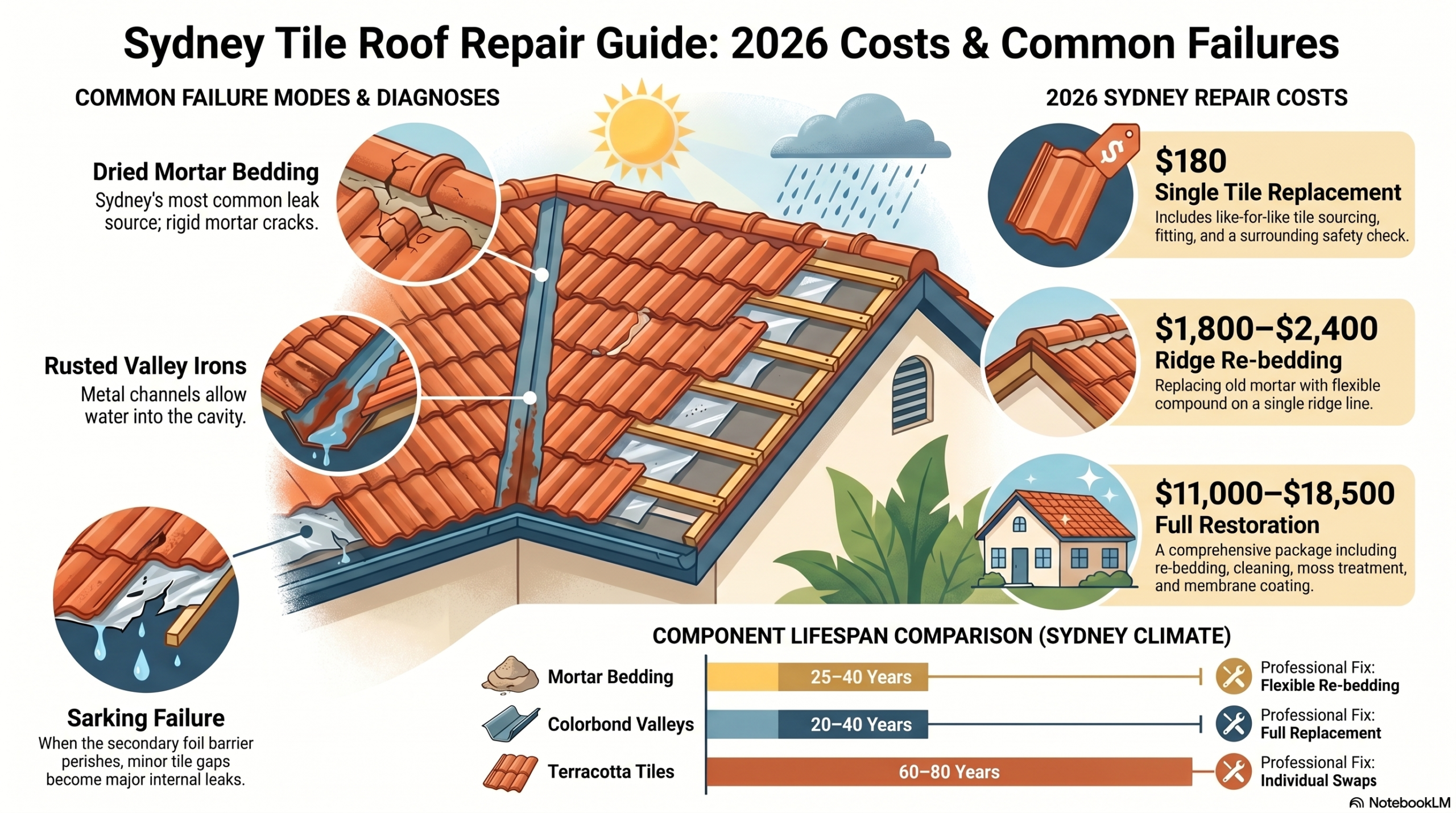
| Single broken tile replacement | $180 | Like-for-like tile sourced and fitted, surrounding tiles checked, mortar pointed if needed |
| Cracked ridge cap (single) | $220 | Cap removed, bedding cleared, new bedding applied, cap re-fitted, pointed |
| Full ridge re-bed and re-point | $1,800–$2,400 (single ridge line) | Old bedding cut out, new flexible bedding compound, new pointing, cap re-aligned |
| Valley iron replacement (single valley) | $1,400–$1,900 | Valley iron removed, sarking checked, new Colorbond valley iron, surrounding tiles re-bedded |
| Tile leak diagnosis + repair (per leak) | $380–$680 | Internal inspection, roof access, leak source identified, source repaired, surrounding tiles checked |
| Re-bedding only (full roof) | $4,800–$7,200 (typical 200 m²) | All ridge and hip lines re-bedded with flexible compound; pointing renewed |
| Re-bedding + re-pointing + roof clean | $6,800–$9,800 | Above plus high-pressure clean, moss treatment |
| Partial re-roof (one elevation) | $4,500–$8,500 | Tiles removed, sarking renewed, battens checked, tiles re-laid (existing tiles where reusable) |
| Full tile roof restoration | $11,000–$18,500 | Re-bed, re-point, clean, moss kill, primer, two coats roof membrane |
These ranges reflect the actual Sydney price spread we see. Inner
West parking restrictions add hours. Coastal jobs in Manly, Bondi or
Maroubra need stainless fixings instead of galvanised. Jobs in heritage
overlay zones (parts of Glebe, Paddington, Balmain) sometimes need
council notification, which adds a day.
What you should be wary of:
- Anyone quoting a “single tile replacement” under $120 is either
undercutting and skipping inspection, or they’re a one-truck operator
without insurance. We carry $20 million public liability and a $5
million indemnity policy because we walk on people’s roofs and sometimes
things go wrong. - “Roof leak repairs from $99”. These are loss-leader ads. The actual
scope of a leak repair is almost never $99 by the time you’re up on the
roof, source identified, and surrounding area properly checked. - “Free roof inspection” followed by a $9,800 quote. If a “free
inspection” produces a bill that big without any structural
justification, get a second opinion. We charge $180 for a proper roof
inspection report and apply that fee against any subsequent repair
work.
What Actually
Goes Wrong on Sydney Tile Roofs
In 14 years on Sydney roofs, the failure modes haven’t really
changed. They cluster into about six categories.
1. Bedding mortar dries
out (most common)
The bedding that holds your ridge caps in place is sand-and-cement
mortar applied when the roof was tiled. It’s rigid. Over 25–40 years in
Sydney’s heat-cool cycle, it cracks. Once it cracks, water gets behind
it. The cap loosens. The next strong wind lifts it.
This is the single most common reason for tile roof leaks in Sydney
we see. The fix is straightforward: re-bed the affected lengths using
flexible bedding compound (Stormseal or similar), then re-point. A
flexible bedding compound flexes through the heat-cool cycle without
cracking. We’ve seen 25-year warranties on flexible bedding hold up.
Where this is worst: Older Federation-era homes in
the Inner West (Annandale, Leichhardt, Newtown), 1960s–70s builds in
Bankstown, Hurstville, Penshurst. Concrete tile roofs from the 70s–80s
in Western Sydney also see this heavily because the concrete tiles
themselves are heavier and stress the bedding more.
2. Cracked or broken
individual tiles
Tiles crack from impact (tradies walking incorrectly, branches
dropping in storms, wildlife landing hard) and from age (terracotta
tiles get brittle past 50 years). A single cracked tile won’t always
leak immediately because the sarking underneath catches it. But sarking
has a lifespan too.
We see this most often after storms. The Sydney hailstorm of October
2022 generated so much repair work that we were booked out for 11 weeks.
Most of those jobs weren’t dramatic, just three to ten broken tiles per
house, but each one needed sourcing the right tile.
Tile sourcing matters. A 1965 Wunderlich terracotta
tile is not the same as a 2010 Monier tile. We keep a stock of common
Sydney tile types, and for the unusual ones we know which yards in
Marrickville and St Marys still hold old stock. Mismatched tile patches
look ugly and often don’t seal properly because the profile is slightly
different.
3. Valley iron rust
The valley iron is the metal channel running between two roof slopes.
It carries roughly twice the water of a normal roof section because
everything from both slopes funnels into it. Galvanised valleys from
before about 1995 typically last 25–35 years. Once they start rusting,
water finds the rust holes and gets into the cavity below.
The first sign is usually a stain on the ceiling near an internal
corner of the house, the place where the two roof slopes meet on the
inside. By the time the stain appears, the valley iron has usually been
leaking for 6–18 months. The sarking underneath is often rotten and the
battens may be soft.
Replacement is a real job. You’re removing 40–60 tiles, cutting out
the old valley iron, fitting Colorbond replacement, then re-bedding the
surrounding tiles. Single valley typically $1,400–$1,900. Two valleys at
the same time is cheaper per valley because the access is already
established.
4. Lifted or displaced
tiles from wind
Sydney’s southerly busters and east coast lows can lift tiles,
especially on south-facing slopes and at gable ends. If the tiles aren’t
mechanically clipped (most pre-2005 tile roofs aren’t), they rely on
weight and bedding alone.
We had a job in Coogee in May 2024 where 23 tiles had lifted along a
single gable line during one south-easterly. None had broken. We re-laid
them, applied tile clips along that vulnerable line, and re-bedded the
ridge. Job took two of us most of a day. $1,260 all in.
5. Sarking failure
Sarking is the foil-faced membrane under the tiles. It’s a secondary
water barrier. On Sydney homes built before about 1985, sarking is often
missing entirely, or has perished to the point where it’s no longer
waterproof. When the primary tile/bedding system has even minor
failures, the sarking is meant to catch the water. When it can’t, leaks
become much more dramatic.
You can usually see failed sarking from inside the roof cavity:
it’ll have visible holes, sagging, or be discoloured grey from sustained
moisture. There’s no quick fix. New sarking means lifting the tiles,
fitting fresh sarking, and re-laying. It’s a partial re-roof.
6. Ridge cap movement at
hip junctions
Hip junctions are where four planes meet (the four corners of a hip
roof). Bedding here takes more thermal stress because all four planes
expand and contract at slightly different rates. We see hip cap movement
most often in homes that face north-east, the corner gets the most
sun.
The fix is the same as standard re-bedding but the geometry is more
fiddly. Allow a half-day for proper hip junction work.
How Long Does a Tile Roof
Repair Last?
Honest answer:
- Single tile replacement: should last as long as
the surrounding tiles (decades), if matched and bedded correctly. - Single ridge cap repair with cement bedding: 5–10
years before the surrounding bedding needs the same treatment. - Single ridge cap repair with flexible bedding:
15–25 years. - Full re-bed and re-point with flexible compound:
20–25 years on most Sydney roofs. Some manufacturers warrant 25
years. - Valley iron replacement (Colorbond): 30–40 years
if salt exposure is moderate. 20–25 years within 2 km of the coast. - Full tile roof restoration with membrane: 12–18
years on the membrane, longer on the underlying tile work.
The single biggest factor in repair longevity isn’t the materials,
it’s whether the diagnosis was right in the first place. We see roofs
every year where someone fixed the symptom (the spot where the
water came through the ceiling) without fixing the source (the
cracked bedding or rusted valley three metres uphill that was sending
water down to that spot). That repair will last about one rainy
season.
When to Repair vs Replace
Sometimes you’re throwing money at a roof that’s structurally given
up. Rough guide for Sydney tile roofs:
- If the tiles are sound but the bedding has gone:
repair. Re-bedding and re-pointing is much cheaper than re-roofing and
gives you another 20+ years. - If the tiles are flaking, cracked across multiple areas, and
the tile profile is no longer manufactured: consider full
re-roof. Patching becomes increasingly impossible. - If the sarking has failed across most of the roof:
consider full re-roof. Lifting all the tiles to replace sarking is most
of the cost of a new roof, so for a relatively small premium you get a
fresh tile roof or a Colorbond conversion. - If you’ve had three or more separate leaks in three
different areas in two years: the roof is signalling
system-wide failure. Patching will cost you more in the next five years
than re-roofing once.
For homeowners in inner Sydney with terracotta tile roofs of
historical/aesthetic value, restoration with re-bedding and a quality
membrane buys you 15–20 more years and preserves the look. For homes
where Colorbond is allowed and aesthetics aren’t tied to the era,
switching to a Colorbond roof during the re-roof gives you 50+ years of
low-maintenance roof and the ability to add proper sarking and
insulation. We tell people honestly which option fits their situation.
We do both.
A Real Repair Job
Job: March 2025: Earlwood – House: 1955
Federation-era brick, terracotta tile roof, single storey – Owner’s
complaint: Two ceiling stains, both worsening over six months –
What we found: Cracked ridge bedding along south-facing main
ridge (8 m affected). Three fractured tiles upstream of one stain.
Valley iron between main roof and back addition had lifted 14 mm and was
no longer fully sealed. Sarking under the affected valley was dry but
starting to cup. – Fix: Re-bedded south ridge with flexible
compound (8 m), replaced 5 tiles (3 fractured + 2 surrounding showing
micro-cracks), removed and replaced valley iron (1.8 m run), re-bedded
surrounding tiles – Cost: $3,840 all in. Broken down as $1,560
ridge re-bed, $720 valley replacement, $480 tile work, $1,080
access/labour/cleanup. – Outcome: Two follow-up rains in April
and a thunderstorm in May 2025. No further leaks. Owner emailed in July
asking us to do her sister’s roof in Marrickville.
We follow up every job at six and 12 months. If a repair leaks within
12 months and it’s a workmanship issue, we come back at no charge.
Booking and Inspections
We service Sydney CBD, the Inner West, Eastern Suburbs, Northern
Beaches, St George area, Sutherland Shire, Canterbury-Bankstown, and
Inner Western Sydney. Our office is in Ultimo. Most quotes can be done
within 5–10 working days; we’ll squeeze in genuine emergency leak
repairs faster. Usually same-week.
For a proper quote, we need to actually see the roof. We don’t quote
from photos because photos miss the things that matter (the back-side of
the ridge, the flashing condition, the sarking state from the cavity).
The inspection takes 30–60 minutes depending on roof complexity.
FAQ
How much is a
single tile replacement in Sydney?
$180 from us, including like-for-like sourcing, fitting, and
surrounding tile check. The cost is mostly labour and roof access, the
tile itself is rarely more than $20.
Can I repair a tile roof
leak myself?
You can replace a single visibly broken tile if you know what you’re
doing and have safe access. Diagnosing a leak source from inside is much
harder than people expect, the water entry point is rarely directly
above the ceiling stain. We see DIY repairs that fix the wrong thing
about half the time.
How long should a
tile roof last in Sydney?
Terracotta tiles themselves last 60–80 years if undisturbed. The
bedding that holds them in place lasts 25–40 years before needing
renewal. Concrete tiles last 50 years and the bedding the same. Sarking,
where present, lasts 30–50 years.
Will my insurance
cover tile roof repair?
Storm damage and tree-fall damage usually yes. Wear-and-tear (cracked
bedding from age) generally no. We help with insurance claim
documentation when the cause is genuinely a covered event: photos,
written reports, dated quotes.
Should I clean my tile roof?
Pressure cleaning is fine for cement tiles. We’re cautious about
pressure cleaning terracotta because it can strip the surface glaze.
Moss treatment with a low-pressure spray is a better approach for older
roofs. Cost: $480–$880 for a treatment depending on roof size.
Do you guarantee your repair
work?
12-month workmanship warranty on all repairs. Manufacturer warranties
on materials separately (flexible bedding compound: 25 years; Colorbond
valley iron: 20 years).
This guide reflects current pricing and practice at Rosella
Roofing Sydney as of April 2026. All work is performed by licensed
roofers under NSW Fair Trading licence. For an inspection or quote, call
our office or use the contact form on this site.